Occupational risks of personnel providing dental services in the Fifth Health Region, 2023
Article Sidebar
Main Article Content
Abstract
Introduction: dental practice involves exposure to biological, ergonomic, physical, and psychosocial risks. In Paraguay, there is a scarcity of recent local data.
Objective: to identify and analyze the occupational risks faced by dental personnel providing services in Paraguay’s Fifth Health Region in 2023.
Methodology: a descriptive cross-sectional study with consecutive sampling. Eligible population (N): dental staff at hospitals in the Fifth Region; n=79 participants. A structured questionnaire with 18 items was administered. Associations by job category were explored using the chi-square test.
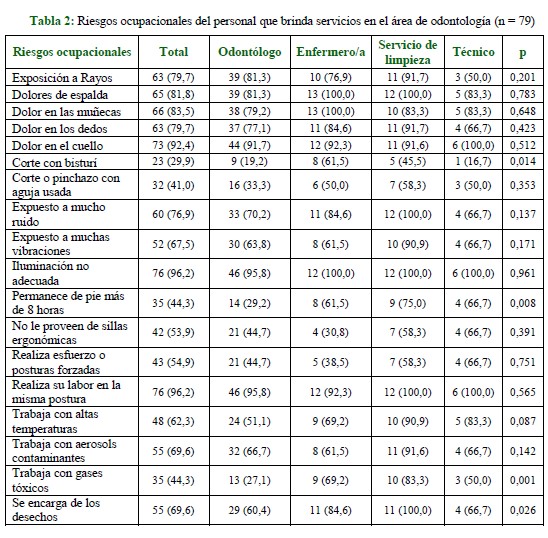
Results: prevalence of occupational risks among 79 participants. More than 90% reported inadequate lighting and prolonged static postures; 92.4% reported neck pain; 83.5% reported wrist pain; and 79.7% reported finger pain. Exposure to X-rays affected 79.7%; 69.6% were exposed to contaminating aerosols; and 44.3% to toxic gases. Significant differences were found by occupational group: scalpel cuts were frequent among nurses (p=0.014), standing for more than 8 hours was common among cleaning staff (p=0.008), and exposure to toxic gases was common among nurses and cleaning staff (p=0.001). Two statistically significant associations with sociodemographic characteristics were identified: women had a higher prevalence of neck pain than men (97.9% vs. 83.9%, p=0.032).
Conclusions: MSDs of the upper extremities and neck are prevalent among workers
Article Details

This work is licensed under a Creative Commons Attribution 4.0 International License.
Usted es libre de:
- Compartir: copiar y redistribuir el material en cualquier medio o formato para cualquier propósito, incluso comercialmente.
- Adaptar: remezclar, transformar y construir a partir del material para cualquier propósito, incluso comercialmente.
- La licenciante no puede revocar estas libertades en tanto usted siga los términos de la licencia
Bajo los siguientes términos:
- Atribución: Usted debe dar crédito de manera adecuada, brindar un enlace a la licencia, e indicar si se han realizado cambios. Puede hacerlo en cualquier forma razonable, pero no de forma tal que sugiera que usted o su uso tienen el apoyo de la licenciante.
- Compartir igual: — Si remezcla, transforma o crea a partir del material, debe distribuir su contribución bajo la misma licencia del original.
- No hay restricciones adicionales — No puede aplicar términos legales ni medidas tecnológicas que restrinjan legalmente a otras a hacer cualquier uso permitido por la licencia.
References
World Health Organization. Occupational health: Health workers. Geneva: WHO; 2021 [citado 15 ago 2023]. Disponible en: https://www.who.int/health-topics/occupational-health
Organización Panamericana de la Salud. Organización Mundial de la Salud. Salud de los Trabajadores. Washington, D.C.: OPS/OMS; 2022 [citado 15 ago 2023]. Disponible en: https://www.paho.org/es/temas/salud-trabajadores
Ogdon Lebrón MA, Díaz-Reissner CV. Síndrome de Burnout en odontólogos de la XVIII Región Sanitaria del Ministerio de Salud Pública y Bienestar Social, Paraguay. Rev. salud publica Parag. 2017;7(1):21-27.
Hermoza-Gutiérrez J, Calle-Gutiérrez A, Ururi-Maye A. Análisis de factores de riesgo laboral en odontología. Rev Odontol Basadrina. 2019;3(2):56-61. doi: 10.33326/26644649.2019.3.2.894
Pardo-Herrera I, Alfonso-Buesaquillo A, Charfuelan M, Enríquez D. Identificación, evaluación, efectos de peligros biológicos en odontología. Cali: Editorial Universidad Santiago de Cali; 2020. p. 29-38.
Carrera Guanga GL, Torres Alvarez JJ, Solís Toapanta YS, Jumbo Salazar EG. Riesgos ocupacionales y bioseguridad en odontologia. Gac médestud. 2024;5(2):e347. Disponible en: https://revgacetaestudiantil.sld.cu/index.php/gme/article/view/347/418
Mercado A, Romero J. Estudio de las condiciones laborales, financieras, grado de expectativas y nivel de satisfacción de los odontólogos generales que trabajan en centros médicos de la ciudad de Cartagena. Colombia: Universidad de Cartagena. 2016
Cázares-de León F, Moral J, Montoya-Flores BI. Validación del Inventario de Ansiedad Dental versión corta en profesionales de la salud oral. Ansiedad y Estrés. 2020;26(1):39-46. doi: 10.20453/reh.v29i4.3636
Iglesias TP, Cangussu MCT, Vianna MIP, Kusterer LEL. Health-related quality of life of dentists in public dental healthcare in Brazil. Journal of Health and Medical Sciences. 2019; 2(3):297-303. doi: 10.31014/aior.1994.02.03.50
Almeida MC, Canini SR, Reis RK, Toffano SE, Pereira FM, Gir E. Clinical treatment adherence of health care workers and students exposed to potentially infectious biological material. Rev Esc Enferm USP. 2015;49(2):261-6. doi: 10.1590/S0080-623420150000200011.
Ayatollahi J, Ayatollahi F, Ardekani AM, Bahrololoomi R, Ayatollahi J, Ayatollahi A, et al. Occupational hazards to dental staff. Dent Res J(Isfahan). 2012;9(1): 2-7. doi: 10.4103/1735-3327.92919
Kinariwala N, Samaranayake LP, Perera I, Patel Z. Concerns and fears of Indian dentists on professional practice during the coronavirus disease 2019 (COVID-19) pandemic. Oral Dis. 2021;27(Suppl 3):730-732. doi: 10.1111/odi.13459
Lietz J, Kozak A, Nienhaus A. Prevalence and occupational risk factors of musculoskeletal diseases and pain among dental professionals in Western countries: a systematic literature review and meta-analysis. PLoS One. 2020;15(5):e0233628. doi: 10.1371/journal.pone.0208628
Pîrvu C, Pătraşcu I, Pîrvu D, Ionescu C. The dentist's operating posture - ergonomic aspects. J Med Life. 2019;7(2):177-182.
Santos RR dos, Garbin CAS, Batista JA, Saliba TA, Garbin AJI. Prevalence of musculoskeletal pain in dental students and associated factors. Braz J. Oral Sci. 2019;18: e191668. Disponible en: https://periodicos.sbu.unicamp.br/ojs/index.php/bjos/article/view/8657270
Lu P, Kong D, Shelley M. Risk perception, preventive behavior, and medical care avoidance among American older adults during the COVID-19 pandemic. J. Aging Health. 2021;33(7-8): 577-584. doi: 10.1177/08982643211002084
Bârlean L, Danila I, Saveanu I, Balcos C. Occupational health problems among dentists in Moldavian Region of Romania. Rev Med Chir Soc Med Nat Iasi. 2013;117(3): 784-788.
Hayes MJ, Cockrell D, Smith DR. A systematic review of musculoskeletal disorders among dental professionals. Int J Dent Hyg. 2009;7(3):159-165. doi: 10.1111/j.1601-5037.2009.00395.x
Droeze EH, Jonsson H. Evaluation of ergonomic interventions to reduce musculoskeletal disorders of dentists in the Netherlands. Work. 2005;25(3):211-220.