Gastroenteritis bacteriana caracterización fenotípica y genotípica de patógenos entéricos aislados de muestras de heces Paraguay. 2024-2025
Barra lateral del artículo
Contenido principal del artículo
Resumen
Introducción: la gastroenteritis infecciosa aguda sigue siendo una de las principales causas de morbilidad y mortalidad infantil en todo el mundo, especialmente en los países en desarrollo.
Objetivos: caracterizar fenotípica y genotípicamente los patógenos entéricos aislados de muestras de heces y evaluar la susceptibilidad antimicrobiana.
Metodología: dstudio retrospectivo, observacional, descriptivo de corte transversal realizado en muestras de heces, remitidas en el periodo 2024-2025. Fueron realizados estudios de identificación y caracterización (métodos convencionales y métodos moleculares) y susceptibilidad antimicrobiana.
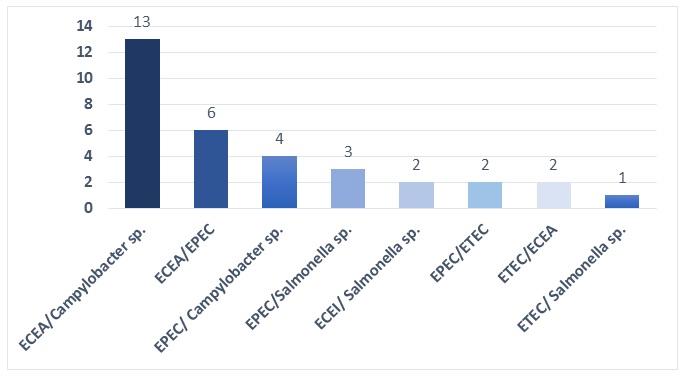
Resultados: de las muestras estudiadas, 28,7 % dieron positivo para algún patógeno entérico bacteriano. E. coli diarreogénicas 54.2 %, Campylobacter spp. 22.8 %, Salmonella spp. 17.8 %, Shigella spp. 5 % y coinfecciones 3.6 %. E. coli enteroagregativa fue de mayor frecuencia dentro de los patotipos estudiados; Campylobacter jejuni en un 93% con presencia de factores de virulencia y una resistencia del 56% a ciprofloxacina. 20 serovariedades de Salmonella sp., fueron identificadas, con sensibilidad intermedia de 19 % para ciprofloxacina. De las Shigella spp., el 72 % correspondieron a S. sonnei, con resistencia antimicrobiana a trimetoprim-sulfametoxazol, ácido nalidixico y ampicilina.
Conclusión: los patógenos entéricos bacterianos continúan representando una causa relevante de gastroenteritis infecciosa en la población estudiada, con predominio de las E. coli diarreogénicas y Campylobacter spp. La diversidad de especies, serovariedades, factores de virulencia y perfiles de susceptibilidad identificados demuestra la necesidad de fortalecer la vigilancia epidemiológica y laboratorial, ampliar el acceso a métodos diagnósticos especializados e implementar medidas de prevención y control adaptadas al contexto nacional.
Detalles del artículo

Esta obra está bajo una licencia internacional Creative Commons Atribución 4.0.
Usted es libre de:
- Compartir: copiar y redistribuir el material en cualquier medio o formato para cualquier propósito, incluso comercialmente.
- Adaptar: remezclar, transformar y construir a partir del material para cualquier propósito, incluso comercialmente.
- La licenciante no puede revocar estas libertades en tanto usted siga los términos de la licencia
Bajo los siguientes términos:
- Atribución: Usted debe dar crédito de manera adecuada, brindar un enlace a la licencia, e indicar si se han realizado cambios. Puede hacerlo en cualquier forma razonable, pero no de forma tal que sugiera que usted o su uso tienen el apoyo de la licenciante.
- Compartir igual: — Si remezcla, transforma o crea a partir del material, debe distribuir su contribución bajo la misma licencia del original.
- No hay restricciones adicionales — No puede aplicar términos legales ni medidas tecnológicas que restrinjan legalmente a otras a hacer cualquier uso permitido por la licencia.
Citas
Zhang SX, Zuo QY, Zheng JX, Wang JC, Chen MX, Qin Y, et al. Co-infection and interaction of enteric pathogens in acute diarrhea among children under five years: a large-scale multicenter observational study from China. Infect Dis Poverty. 2025 ;14(1):122. doi: 10.1186/s40249-02501392-8.
Al-Mashahedah A, Dhahi R. Enteric pathogens implicated in acute infectious diarrhea among young children in resource-limited region with rapidly growing population: a hospital-based crosssectional study. Clin ExpPediatr. 2025;68(5):379-387. doi: 10.3345/cep.2024.01333.
ShaneA, Gonzalez M, Roy A, Preidis G, Woodworth M. State-of-the-Art Review: infectious diarrhea. Clin Infect Dis. 2025; 81 (5):250–262. doi: 10.1093/cid/ciaf356
Galeano N, El Haj F. Prevalencia de agentes productores de diarreas en pacientes con gastroenteritis que asisten al laboratorio central de microbiología del hospital de clínicas, Paraguay (2014-2017). Facultad de Ciencias Médicas. Universidad Nacional de Asunción, Paraguay. Discover Medicine. 2019;3(1): 25-30. Disponible en: https://revistascientificas.una.py/index.php/DM/article/view/3121/2722
Huber C, Orrego M, Ortiz F, Alvarez M, Weiler N. Prevalencia de patógenos causantes de enfermedad diarreica aguda en el área Metropolitana de Asunción y Central. Rev. salud pública Paraguay.2019;9(2):41-45. doi: 10.18004/rspp.2019.diciembre.41-45
Mileto I, Romano G, Gaiarsa S, Grassia G, Bagnarino J, Piralla A, et al. Whole genome sequencing as a reliable alternative for Salmonella serotyping: a comparative study with the goldstandard method. Front Microbiol. 2025;16:1685741. doi: 10.3389/fmicb.2025.1685741
Awad A, Ye H, Ramadan H, Rothrock MJ. Genotypic characterization, antimicrobial susceptibility and virulence determinants of Campylobacter jejuni and Campylobacter coli isolated from pastured poultry farms. Front Microbiol. 2023;14:1271551. doi: 10.3389/fmicb.2023.1271551
Mathers AJ, Lewis JS, Bryson AL, Alby K, Bobenchik AM, Campeau Sh, et al. CLSI M100Ed35 Performance standards for antimicrobial susceptibility testing. Standards. 36th Ed, Clinical and Laboratory Standards Institute. 2026.
Clinical and Laboratory Standards Institute. Methods for antimicrobial dilution and disk susceptibility testing of infrequently isolated or fastidious bacteria: M45. 3rd Ed. Wayne, Pennsylvania: Clinical and Laboratory Standards Institute. 2016; 16, 39 p. Disponible en: https://cdn.bfldr.com/YLD4EVFU/at/btqtmwvntgh75b26jv6tbgf3/m45ed3_sample.pdf
Orrego M. POE Aislamiento y Caracterización Fenotípica E. coli diarreogénicas spp. Procedimiento Operativo Estandar. Laboratorio Central de Salud Pública. 2019.
Wysok B, Wojtacka J, Hänninen ML, Kivistö R. Antimicrobial resistance and virulenceassociated markers in Campylobacter strains from diarrheic and non-diarrheic humans in Poland. Front Microbiol. 2020;11:1799. doi: 10.3389/fmicb.2020.01799
Keng B, Han P, Low A, Aung KT, Khor WC, Maiwald M, et al. Epidemiology of diarrheagenic pathogens in acute hospitals in Singapore: a retrospective multicenter study. Microbiol Spectr. 2025;13(12):e0272525. doi: 10.1128/spectrum.02725-25.
Rojas-Renjifo K, Urrego L. Enfermedades transmitidas por alimentos: diarrea. Revista ReCiTeIA. 2021;19:25-40.
Cuesta J, Armijos J, Gallego O, Castilla R. Rehidratación en niños con gastroenteritis aguda, ¿oral o intravenosa? Polo del Conoc. 2022;7(11):2140-2151.
Gaspar C, Rios P, MoellerT. Landscape of Bacterial Enteric Disease and Traveler´s Diarrhea in South America. J Infect Dis. 2025;231(1): 10-–S18. doi: 10.1093/infdis/jiae594
Zenebe T, Endewunet E, Seman A, Eguale T, Abebe T. Epidemiology of Shigella, Salmonella, and Campylobacter amongdiarrheic under-five-year-old children in central Ethiopia. J Infect Dev Ctries. 2025;19(4):597-607. doi: 10.3855/jidc.19921
Acebo-Gutiérrez JM, Carreño-Palma NJ, Cañarte-Vélez JC. Epidemiología y diagnóstico de enteropatógenos asociados a gastroenteritis aguda. MQR Investigar. 2023;7(1):411–30. doi: 10.56048/MQR20225.7.1.2023.411-430
Piguave-Reyes J, Castellano-González M, Pionce-Pibaque M, Ávila-Ávila J. Etiología de la diarrea infantil en Shushufindi, Ecuador. Kasmera. 2019;47(1):21–8. Disponible en: https://drive.google.com/file/d/1YjiFtvLa0N13ijr2sb46QHtP9uL1WEo4/view
Weiler N, Orrego M, Alvarez M, Huber C. Detección molecular de Escherichia coli diarreogénica en pacientes pediátricos con síndrome diarreico agudo. Mem. Inst. Investig. Cienc. Salud. 2017; 15(1):16-21. doi: 10.18004/mem.iics/1812-9528/2017.015(01)16-021
Molina NB, Oderiz S, Vescina C, Córdoba A, Basualdo JA, Sparo MD. First report of diarrheagenic Escherichia coli in pediatric outpatient population with diarrhea in La Plata, Argentina. Rev ArgMicrobiol.2022;54(1):15-21. doi: 10.1016/j.ram.2021.02.006
Pajuelo MJ, Noazin S, Cabrera L, Toledo A, Velagic M, Arias L, et al. Epidemiology of enterotoxigenic Escherichia coli and impact on the growth of children in the first two years of life in Lima, Peru. Front Public Health. 2024;12:1332319. doi: 10.3389/fpubh.2024.1332319
Shahbazi G, Rezaee MA, Nikkhahi F, Ebrahimzadeh S, Hemmati F, Barzegarzadeh Namarvar B, et al. Characteristics of diarrheagenic Escherichia coli pathotypes among children under the age of 10 years with acute diarrhea. Gene Rep. 2021;25:101318. doi: 10.1016/j.genrep.2021.101318
Ohmura-Hoshino M, Miyaki Y, Yashima S. A one-step multiplex PCR-based assay for simultaneous detection and classification of virulence factors to identify five diarrheagenic Escherichia coli pathotypes. Heliyon. 2022;8(8):e10231. doi: 10.1016/j.heliyon.2022.e10231
Molina NB, Oderiz S, López MA, Basualdo JA, Sparo MD. Molecular characterization of diarrheagenic Escherichia coli from an outpatient pediatric population with diarrhea attended in two hospitals from Buenos Aires, Argentina. Rev. Argent. Microbiol. 2024;56(1):8-15. doi: 10.1016/j.ram.2023.06.002
Aquili V, González A, Spoleti MJ, Casabonne C. Detección molecular de patotipos de Escherichia coli productores de enfermedad diarreica aguda en niños en un hospital de Rosario, Argentina. Hechos Microbiol. 2023;14(1). doi: 10.17533/udea.hm.v14n1a03
Dato L, Mancuso MC, Daprai L, Ria T, Rossetti D, Callegaro A, et al. Bloody diarrhea, STEC infection, and HUS in the molecular microbiology era. Pediatr Nephrol. 2026;41(4):973–980. doi: 10.1007/s00467-025-06930-y
Zotta CM, Lavayén S, Deza N, Cepeda M, Zolezzi G, et al. Infecciones por Escherichia coli productora de toxina Shiga O121:H19 en pacientes atendidos en Mar del Plata. Acta Bioquím Clín Latinoam. 2019;53(2):193-201. Disponible en: https://www.scielo.org.ar/pdf/abcl/v53n2/v53n2a06.pdf
Galarce N, Sánchez F, Escobar B, Lapierre L, Cornejo J, Alegría-Morán R et al. Genomic epidemiology of shiga toxin-producing Escherichia coli isolated from the live stock-food-human interface in South America. Animals (Basel). 2021;11(7):1845. doi: 10.3390/ani11071845
Liu F, Lee SA, Xue J, Riordan SM, Zhang L. Global epidemiology of campylo bacteriosis and the impact of COVID-19. Front Cell Infect Microbiol. 2022;12:979055. doi: 10.3389/fcimb.2022.979055
Porte L, Pérez C, Barbé M, Varela C, Vollrath V, Legarraga P, Weitzel T, et al. Campylobacter spp. Prevalence in Santiago, Chile: a study based on molecular detection in clinical stool samples from 2014 to 2019. Pathogens. 2023;12(3):504. doi: 10.3390/pathogens12030504
St Jean D, Herrera R, Pérez C, Gutiérrez L, Vielot NA, González F, et al. Clinical characteristics, risk factors, and population attributable fraction for campylo bacteriosis in a Nicaraguan birth cohort. Am J Trop Med Hyg. 2021;104(4):1215-1221. doi: 10.4269/ajtmh.201317
Schreyer ME, Olivero CR, Rossler E, Soto LP, Frizzo LS, Zimmermann JA, et al. Prevalence and antimicrobial resistance of Campylobacter jejuni and C. coli identified in a slaughterhouse in Argentina. Curr Res Food Sci. 2022;5:590-597. doi: 10.1016/j.crfs.2022.03.005
Orrego MV, Weiler N, Alvarez M, Ortiz F, Martinez J, Duarte R, et al. Perfil de virulencia y resistencia antimicrobiana en cepas de Campylobacter spp., aislados de pacientes con síndrome diarreico agudo en el Laboratorio Central de Salud Pública, periodo 2020 - 2021. Rev. salud pública Parag. 2023;13(2):22-28.doi: 10.18004/rspp.2023.agost.05
Portes AB, Panzenhagen P, Pereira dos Santos AM, Junior CAC. Antibiotic resistance in Campylobacter: asystematic review of South American Isolates. Antibiotics (Basel). 2023; 12(3):548. doi: 10.3390/antibiotics12030548
Shahbazova M, Çiftçi N, Türk H, Arslan U. Investigation of Virulence Genes in Campylobacter Species Isolated from Patients with Acute Diarrhea. Mikrobiyol Bul. 2025;59(1):1–14. doi: 10.5578/mb.20250192
Tikhomirova A, McNabb ER, Petterlin L, Bellamy GL, Lin KH, Santoso CA, et al. Campylobacter jejuni virulence factors: update on emerging issues and trends. J Biomed Sci. 2024;31(1):45. doi: 10.1186/s12929-024-01033-6
Mai Q, Lai W, Deng W, Guo J, Luo Y, Bai R, et al. Prevalence, Serotypes and Antimicrobial resistance of Salmonella isolated from children in Guangzhou, China, 2018-2023. Infect Drug Resist. 2024;17:4511-4520. doi: 10.2147/IDR.S486907
Amparo L, Machado S, Salles D. Salmonella serovars associated with human salmonellosis in Brazil. Research, Society and Development. 2022;11(8):e28011830533. doi: 10.33448/rsdv11i8.30533
Rosso F, Rebellón-Sánchez DE, Llanos-Torres J, Hurtado-Bermudez LJ, Ayerbe L, Suárez JH, et al. Clinical and microbiological characterizationof Salmonella spp. Isolates from patients treated in a university hospital in South America between 2012–2021: a cohortstudy. BMC Infect Dis. 2023;23(1):625. doi: 10.1186/s12879-023-08589-y
Ortiz F, Weiler N, Alvarez M, Orrego MV, Kawabata A, Riera E, et al. Resistencia serovariedades a múltiples de antibióticos en salmonella aisladas de muestras clínicas y alimentos. Mem. Inst. Investig. Cienc. Salud. 2021;19(1): 37-47. doi:10.18004/mem.iics/18129528/2021.019.01.37
Xiang Y, Zhu K, Min K, Zhang Y, Liu J, Liu K, et al. Characterization of a Salmonella enteric serovar Typhimurium lineagewith rough colonymorphology and multidrugresistance. Nat Commun. 2024;15(1):6123. doi: 10.1038/s41467-024-50331-y
Grenon, S, Leguizamón L, Del Valle A, Pallares S, Salvi M, Von M. Prevalence and antimicrobial profile of Shigella causing acute diarrheal disease in pediatrics in Posadas, Misiones. RECyT. 2022;38(1): 71–75. doi: 10.36995/j.recyt.2022.38.009
Bose P, Chowdhury G, Halder G, Ghosh D, Deb AK, Kitahara K, et al. Prevalence and changing antimicrobial resistance profiles of Shigella spp. Isolated from diarrheal patients in Kolkata during 2011–2019. PLoS Negl Trop Dis. 2024;18(2):e0011964. doi: 10.1371/journal.pntd.0011964
NyarkohR, Odoom A,DonkorE. Prevalence of Shigella species and antimicrobial resistance patterns in Africa: systematic review and meta‑analysis. BMC Infect Dis.2024;24(1217):2-15. doi: 10.1186/s12879-024-09945-2
Gonzales JC, Seribelli AA, Gomes CN, Rodrigues DP, Campioni F, Passaglia J, et al. A high number of multidrug-resistant and predominant genetically related cluster of Shigella flexneri strains isolated over 34 years in Brazil. Braz J Microbiol. 2020;51(4):1563-1571. doi: 10.1007/s42770-020-00332-y
Kambiré D, Ouédraogo O, Tondé I, Sankara F, Tamboura M, Paré R, et al. Antibiotics susceptibility of Salmonella spp and Shigella spp strains isolated from coprocultures. Int J Curr Microbiol Appl Sci. 2024;13(10):174–184. doi: 10.20546/ijcmas.2024.1310.022
Muse K, Urgessa K, Shume T, Tahir B, Weldegebreal F. Prevalence, associated factors and antimicrobial susceptibility patterns of Salmonella and Shigella species among diarrheic under five children in Sultan Sheik Hassan Yabere referral Hospital, Jigjiga, Eastern Ethiopia. BMC Pediatr. 2024;24: 311. doi: 10.1186/s12887-024-04755-6
Yacarini A, Arriaga E, Beltrán RA. Detección de patotipos de cepas de Escherichia coli causantes de diarrea infantil de establecimientos de salud de la región Lambayeque-Perú, 2018. Rev Cuerpo Méd HNAAA. 2020; 13(3):299-302. doi: 10.35434/rcmhnaaa.2020.133.741
Orrego M, Ortiz F, Alvarez M, Duarte R, Colman J, Moreno L, Hamuy R, Weiler N, et al. Datase ton the etiological characterization of acute diarrheal disease cases in Paraguay, 2024-2025. [Dataset]. Zenodo. https://doi.org/10.5281/zenodo.21650165