Measurement invariance by sex and age of the Patient Health Questionnaire (PHQ-4) in Shipibo-Konibo native communities of Ucayali, Perú
Article Sidebar
Main Article Content
Abstract
Introduction: the Patient Health Questionnaire-4 (PHQ-4) is an ultra-brief instrument widely used for assessing symptoms of anxiety and depression; however, it lacks formal adaptation in Amazonian languages.
Objective: to evaluate the measurement invariance of the Patient Health Questionnaire (PHQ-4) with respect to sex and age in Shipibo-Konibo native communities of Ucayali, Peru.
Methodology: the study has a cross-sectional design.The linguistically and culturally adapted version of the PHQ-4 was administered to 150 participants selected by non-probability sampling.
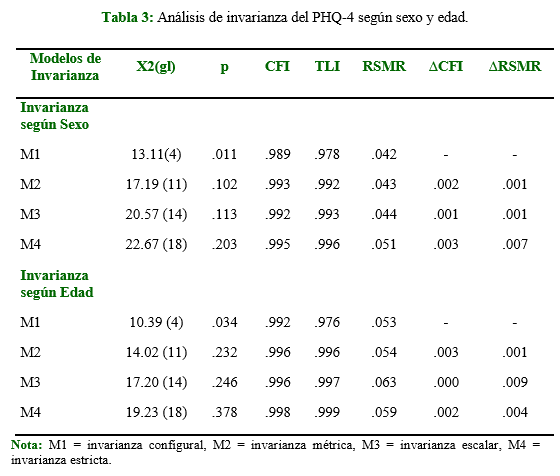
Results: Confirmatory Factor Analysis (CFA) showed that the unifactorial model of the Shipibo version of the PHQ-4 was the most appropriate and consistent with the holistic worldview of this community (CFI = .99, TLI = .97, SRMR = .03). Strict invariance was also observed by sex and age; no differences were found in mean scores between men and women, while differences were found according to age, with greater symptomatology in the 36 and older age group.
Conclusion: the PHQ-4 is an invariant measure for assessing symptoms of anxiety and depression in different sex and age groups within the bilingual Shipibo-Konibo community.
Article Details

This work is licensed under a Creative Commons Attribution 4.0 International License.
Usted es libre de:
- Compartir: copiar y redistribuir el material en cualquier medio o formato para cualquier propósito, incluso comercialmente.
- Adaptar: remezclar, transformar y construir a partir del material para cualquier propósito, incluso comercialmente.
- La licenciante no puede revocar estas libertades en tanto usted siga los términos de la licencia
Bajo los siguientes términos:
- Atribución: Usted debe dar crédito de manera adecuada, brindar un enlace a la licencia, e indicar si se han realizado cambios. Puede hacerlo en cualquier forma razonable, pero no de forma tal que sugiera que usted o su uso tienen el apoyo de la licenciante.
- Compartir igual: — Si remezcla, transforma o crea a partir del material, debe distribuir su contribución bajo la misma licencia del original.
- No hay restricciones adicionales — No puede aplicar términos legales ni medidas tecnológicas que restrinjan legalmente a otras a hacer cualquier uso permitido por la licencia.
References
Trianni A, Tausch A, Souza RO. Promoviendo la salud mental en las Américas: retos y oportunidades. Cad. Sáude Publica. 2025; 41(9): e00162325. doi: 10.1590/0102-311XES162325
World Health Organization. Global statistics on depression and anxiety. Ginebra: WHO; 2024 [citado 2025]. Disponible en: https://www.who.int/data
Organización Panamericana de la Salud. La pandemia de COVID-19 aumenta en un 25 % la prevalencia de la ansiedad y la depresión en todo el mundo. Washington, DC: OPS; 2022. Disponible en: https://www.who.int/es/news/item/02-03-2022-covid-19-pandemic-triggers-25-increase-in-prevalence-of-anxiety-and-depression-worldwide
Pan American Health Organization. Mental health and COVID-19 in the Americas. Washington, DC.: PAHO; 2023. Disponible en: https://www.paho.org/en/mental-health-and-covid-19
Zhang SX, Batra K, Xu W, Liu T, Dong RK, Yin A, et al. Mental disorder symptoms during the COVID-19 pandemic in Latin America: a systematic review and meta-analysis. Epidemiol Psychiatr Sci. 2022;31:e23. doi: 10.1017/S2045796021000767.
Ministerio de Salud. Establecimientos del MINSA atendieron más de 250000 casos de depresión a lo largo del año 2024. Lima: Ministerio de Salud; 2025.
Moreno G. Salud mental en Perú 2026: cifras, brechas y dónde buscar ayuda; 2026. Disponible en: https://origen.pe/blog/salud-mental-peru-crisis-datos/
Ministerio de Cultura. Pueblo indígena Shipibo-Konibo. Banco de Datos de Pueblos Indígenas del Perú. Lima. MINCUL; 2017. Disponible en: https://bdpi.cultura.gob.pe/sites/default/files/archivos/pueblos_indigenas/Ficha%20Shipibo-Konibo_0.pdf
Contreras-Pulache H, Pérez-Campos P, Huapaya-Huertas O, Chacón-Torrico H, Champin-Mimbela D, Freyre-Adrianzén L, Black-Tam C. La salud en las comunidades nativas amazónicas del Perú. Rev Peruana Epid. 2014;18(1):1-5. Disponible en: https://www.redalyc.org/pdf/2031/203131355012.pdf
Organización Regional de Pueblos Indígenas del Oriente. Problema social silencioso: suicidios de jóvenes indígenas en Loreto. Iquitos. Organización Regional de Pueblos Indígenas del Oriente; 2024. Disponible en: https://www.servindi.org/actualidad/146442
EsSalud Ucayali. El 70 % de pacientes del servicio de psicología sufren de depresión y ansiedad. Lima: EsSalud; 2018. Disponible en: https://www.essalud.gob.pe/essalud-ucayali-el-70-de-pacientes-del-servicio-de-psicologia-sufren-de-depresion-y-ansiedad/
Carranza Esteban RF, Mamani-Benito O, Cjuno J, Tito-Betancur M, Caycho-Rodríguez T, Vilca LW, et al. Adaptation and validation of the Patient Health Questionnaire for Depression and Anxiety (PHQ-4) in a sample of quechua-speaking Peruvians. Med Clín Soc. 2024;8(1):63-74.doi: 10.52379/mcs.v8i1.361
Ministerio de Salud. Análisis de la situación de salud del pueblo Shipibo-Konibo. Lima. Ministerio de Salud; 2014.
Kroenke K, Spitzer RL, Williams JBW, Löwe B. An ultra-brief screening scale for anxiety and depression: the PHQ-4. Psychosomatics. 2009;50(6):613-21. doi: 10.1016/S0033-3182(09)70864-3.
Stanhope J. PatientHealth Questionnaire-4. Occup Med (Lond). 2016; 66(9): 760-1. doi: 10.1093/occmed/kqw165.
Caycho-Rodríguez T, Travezaño-Cabrera A, Torales J, Barrios I, Vilca LW, Samaniego-Pinho A, et al. Psychometric network analysis of the PHQ-4 in the Paraguayan general population. Psicol Reflex Crit. 2024;37(15):1-13. doi: 10.1186/s41155-024-00299-x
Van de Schoot R, Schmidt P, De Beuckelaer A, Lek K, Zondervan-Zwijnenburg M. Measurement invariance. Front Psychol. 2015;6:1064. doi: 10.3389/fpsyg.2015.01064.
Vandenberg RJ, Lance CE. A review and synthesis of the measurement invariance literature. Organ Res Methods. 2000;3(1):4-70. doi: 10.1177/109442810031002.
Carbajal-León C, Caycho-Rodríguez T, Yupanqui-Lorenzo DE, Lino-Cruz C, Cabrera Orosco I, Ventura- León J, et al. Evidencia empírica para un modelo unidimensional o bidimensional del PHQ-4 en población peruana en duelo. Med Clín Soc. 2024; 8(3): 250-62. doi: 10.52379/mcs.v8i3.425.
Soper DS. A-priori Sample Size Calculator for Structural Equation Models [Internet]. 2021 [citado 2025 Jun 27]. Disponible en: https://www.danielsoper.com/statcalc/calculator.aspx?id=89
Hernández A, Hidalgo MD, Hambleton RK, Gómez-Benito J. International Test Commission guidelines for test adaptation: a criterion checklist. Psicothema. 2020;32(3):390-8. doi: 10.7334/psicothema2019.306.
Brown TA. Confirmatory factor analysis for applied research. 2nd ed. New York: Guilford Press; 2015.462 p.
Kline RB. Principles and practice of structural equation modeling. 4th ed. New York: Guilford Press; 2016. 534 p.
Schumacker RE, Lomax RG. A beginner’s guide structural equation modeling. 4th ed. New York: Routledge; 2015. doi: 10.4324/9780203851319.
Cronbach LJ. Coefficient alpha and the internal structure of tests. Psychometrika. 1951;16(3):297-334. doi: 10.1007/BF02310555.
McDonald RP. Test theory: a unified treatment. Mahwah. Lawrence Erlbaum Associates; 1999.doi: 10.4324/9781410601087
Tucker LR, Lewis C. A reliability coefficient for maximum likelihood factor analysis. Psychometrika. 1973; 38(1): 1-10.doi: 10.1007/BF02291170
Cheung GW, Rensvold RB. Evaluating goodness-of-fit indexes for testing measurement invariance. Struct Equ Modeling. 2002;9(2):233-55. doi: 10.1207/S15328007SEM0902_5.
World Medical Association. World Medical Association Declaration of Helsinki: ethical principles for medical research involving human subjects. JAMA. 2013;310(20):2191-4. doi: 10.1001/jama.2013.281053.
Beck AT. Depression: clinical, experimental, and theoretical aspects. Philadelphia. University of Pennsylvania Press; 1967.
Löwe B, Wahl I, Rose M, Spitzer C, Glaesmer H, Wingenfeld K, et al. A 4-item measure of depression and anxiety: validation and standardization of the PHQ-4 in the general population. J Affect Disord. 2010;122(1-2): 86-95. doi: 10.1016/j.jad.2009.06.019.
Caycho-Rodríguez T, Vilca LW, Ventura-León J, Valencia PD, Carbajal-León C, Reyes-Bossio M, et al. Cross-national measurement invariance of the PHQ-4 in 12 Latin American countries. Psychol Thought. 2024; 17(2): 450-82. doi: 10.37708/psyct.v17i2.931.
Van de Schoot R, Lugtig P, Hox J. A checklist for testing measurement invariance. Eur J Dev Psychol. 2012;9(4):486-92. doi: 10.1080/17405629.2012.686740.
Universidad Iberoamericana Ciudad de México. La experiencia del dolor, en las mismas áreas cerebrales que la empatía. Ciudad de México: IBERO; 2023 [2026 Feb 2]. Disponible en: https://ibero.mx/prensa/la-experiencia-del-dolor-en-las-mismas-areas-cerebrales-que-la-empatia
University of Utah. Genetic Science Learning Center. How pain works in the body and brain. Salt Lake City: University of Utah; [2026 Feb 2]. Disponible en: https://learn.genetics.utah.edu/content/addiction/howpainworks/
Belzer K, Schneier FR. Comorbidity of anxiety and depressive disorders: issues in conceptualization, assessment, and treatment. J Psychiatr Pract. 2004; 10(5): 296-306. Disponible en: https://journals.lww.com/practicalpsychiatry/abstract/2004/09000/comorbidity_of_anxiety_and_depressiv e_disorders_.3.aspx
Hirschfeld RMA. The comorbidity of major depression and anxiety disorders: recognition and management in primary care. Prim Care Companion J Clin Psychiatry. 2001;3(6):244-54. doi: 10.4088/pcc.v03n0609.
Konac T, Young KS, Lau JYF, Barker ED. Network analysis of depression and anxiety symptoms: bridge symptoms and clinical implications. J Affect Disord. 2021; 281:256-263. doi: 10.1016/j.jad.2020.12.002.
Putnick DL, Bornstein MH. Measurement invariance conventions and reporting: The state of the art and future directions for psychological research. Dev Rev. 2016; 41: 71-90.doi: 10.1016/j.dr.2016.06.004
World Health Organization.World mental health report: transforming mental health for all. Ginebra: WHO; 2022. Disponible en: https://www.who.int/publications/i/item/9789240049338
World Health Organization. Depressive disorder (depression). 2025. Disponible en: https://www.who.int/news-room/fact-sheets/detail/depression
Sánchez-Villena AR, Ventura-León J. Depresión según identidad étnica en población peruana: un estudio nacional mediante análisis de redes. Acta Colombiana Psicol. 2024; 27(1): 181-194. doi: 10.14718/acp.2024.27.1.10
Rojas M. Salud mental e interculturalidad en la Amazonía. Lima: Diario Oficial del Bicentenario El Peruano. 2023. Disponible en: https://www.elperuano.pe/noticia/214853-salud-mental-e-interculturalidad-en-la-amazonia
Carr D, Pudrovska T. Midlife and Mental Health. Encyclopedia of Mental Health (Second Edition). 2016:133-136. doi: 10.1016/B978-0-12-397045-9.00109-9.
Monsalve M, Cuéllar A. Ansiedad por calor y duelo por la pérdida de tierras: el cambio climático nos manda a terapia. El País. 2025[citado 2025 nov 27]. Disponible en: https://elpais.com/america-futura/2025-04-11/ansiedad-por-calor-y-duelo-por-la-perdida-de-tierras-el-cambio-climatico-nos-manda-a-terapia.html
Shapero BG, Black SK, LiuRT, Klugman J, Bender RE, Abramson LY, Alloy LB. Stressful life events and depression symptoms: the effect of childhood emotional abuse on stress reactivity. J Clin Psychol. 2014; 70(3): 209-23.doi: 10.1002/jclp.22011
San Sebastián M, Hurtig AK. Oilexploitation in the Amazon basin of Ecuador: a public health emergency. Rev Panam Salud Publica. 2004;15(3):205-11. doi: 10.1590/S1020-49892004000300009.
Moya-Salazar J, Jaime-Quispe A, Cañari B, Moya-Espinoza JG, Contreras-Pulache H. A systematic review of mental health in rural Andean populations in Latin America during the COVID-19 pandemic. Front Psychiatry. 2023; 14: 1136328. doi: 10.3389/fpsyt.2023.1136328
Naciones Unidas. Transformar nuestro mundo: la Agenda 2030 para el Desarrollo Sostenible. Nueva York. Naciones Unidas; 2015. Disponible en: https://unctad.org/system/files/official-document/ares70d1_es.pdf