Prevalence of atrial fibrillation in patients with ischemic stroke
Article Sidebar
Main Article Content
Abstract
Introduction: Atrial fibrillation is the most common cardiac arrhythmia and is associated with an increased risk of ischemic stroke.
Objective: To determine the frequency of atrial fibrillation and the clinical characteristics of patients with ischemic stroke admitted to the Stroke Unit of Hospital de Clínicas between 2018 and 2023.
Methods: An observational, descriptive, cross-sectional, retrospective study was conducted using non-probability sampling. Patients aged ≥40 years with ischemic stroke admitted between January 2018 and December 2023 were included. Sociodemographic variables, cardiovascular risk factors, antiplatelet therapy, thrombolysis, and length of hospital stay were analyzed.
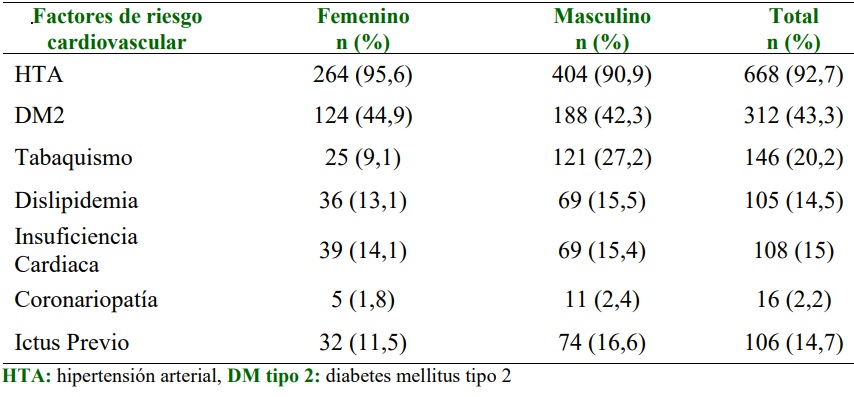
Results: A total of 720 patients were included; the frequency of atrial fibrillation was 17.7%. The mean age was 65.4 ± 11.3 years, and 61.6% were male. The main cardiovascular risk factors were hypertension, type 2 diabetes mellitus, and smoking. Prior to admission, 2.7% of patients were receiving antiplatelet therapy, compared with 79.5% at discharge. Thrombolysis was performed in 15.5% of patients. Among those with atrial fibrillation, 42% were receiving prior anticoagulation. The mean time from hospital admission to thrombolysis was 48 ± 5 minutes, while the mean time from symptom onset to thrombolysis was 186 ± 3 minutes. The mean length of hospital stay was 6.1 ± 3 days.
Conclusion: Atrial fibrillation was frequent among patients with ischemic stroke. Hypertension and type 2 diabetes mellitus were the most prevalent cardiovascular risk factors. Thrombolysis was performed in a low proportion of patients, whereas antiplatelet therapy use increased considerably by discharge.
Article Details

This work is licensed under a Creative Commons Attribution 4.0 International License.
Usted es libre de:
- Compartir: copiar y redistribuir el material en cualquier medio o formato para cualquier propósito, incluso comercialmente.
- Adaptar: remezclar, transformar y construir a partir del material para cualquier propósito, incluso comercialmente.
- La licenciante no puede revocar estas libertades en tanto usted siga los términos de la licencia
Bajo los siguientes términos:
- Atribución: Usted debe dar crédito de manera adecuada, brindar un enlace a la licencia, e indicar si se han realizado cambios. Puede hacerlo en cualquier forma razonable, pero no de forma tal que sugiera que usted o su uso tienen el apoyo de la licenciante.
- Compartir igual: — Si remezcla, transforma o crea a partir del material, debe distribuir su contribución bajo la misma licencia del original.
- No hay restricciones adicionales — No puede aplicar términos legales ni medidas tecnológicas que restrinjan legalmente a otras a hacer cualquier uso permitido por la licencia.
References
Sagris M, Vardas EP, Theofilis P, Antonopoulos AS, Oikonomou E, Tousoulis D. Atrial fibrillation: pathogenesis, predisposing factors, and genetics. Int J Mol Sci. 2021;23(1):6. doi: 10.3390/ijms23010006
Staerk L, Sherer JA, Ko D, Benjamin EJ, Helm RH. Atrial fibrillation: epidemiology, pathophysiology, and clinical outcomes. Circ Res. 2017;120(9):1501-17. doi: 10.1161/CIRCRESAHA.117.309732
Elsheikh S, Hill A, Irving G, Lip GYH, Abdul-Rahim AH. Atrial fibrillation and stroke: state-ofthe-art and future directions. Curr Probl Cardiol. 2024;49(1 Pt C):102181. doi: 10.1016/j.cpcardiol.2023.102181
Lip GYH, Proietti M, Potpara T, Mansour M, Savelieva I, Tse HF, et al. Atrial fibrillation and stroke prevention: 25 years of research at EP Europace journal. Eurpace. 2023;25(9):euad226. doi: 10.1093/europace/euad226
January CT, Wann LS, Calkins H, Chen LY, Cigarroa JE, Cleveland JC, et al. 2019 AHA/ACC/HRS Focused Update of the 2014 AHA/ACC/HRS Guideline for the Management of patients with atrial fibrillation. J Am Coll Cardiol. 2019;74(1):104-32. doi: 10.1016/j.jacc.2019.01.011
Kornej J, Börschel CS, Benjamin EJ, Schnabel RB. Epidemiology of Atrial Fibrillation in the 21st Century: Novel Methods and New Insights. Circ Res. 2020;127(1):4-20. doi: 10.1161/CIRCRESAHA.120.316340
Chugh SS, Havmoeller R, Narayanan K, Singh D, Rienstra M, Benjamin EJ, et al. Worldwide epidemiology of atrial fibrillation: a Global Burden of Disease 2010 Study. Circulation. 2014;129(8):837-47. doi: 10.1161/CIRCULATIONAHA.113.005119
Seiffge DJ, Cancelloni V, Räber L, Paciaroni M, Metzner A, Kirchhof P, et al. Secondary stroke prevention in people with atrial fibrillation: treatments and trials. Lancet Neurol. 2024;23(4):404-17. doi: 10.1016/S1474-4422(24)00037-1
Perera KS, Vanassche T, Bosch J, Swaminathan B, Mundl H, Giruparajah M, et al. Global Survey of the frequency of atrial fibrillation-associated stroke: embolic stroke of undetermined source global registry. Stroke. 2016;47(9):2197-202. doi: 10.1161/STROKEAHA.116.013378
Jerjes-Sanchez C, Corbalan R, Barretto ACP, Luciardi HL, Allu J, Illingworth L, et al. Stroke prevention in patients from Latin American countries with non-valvular atrial fibrillation: Insights from the GARFIELD-AF registry. Clin Cardiol. 2019;42(5):553-60. doi: 10.1002/clc.23176
Cantú-Brito C, Silva GS, Ameriso SF. Use of Guidelines for Reducing Stroke Risk in patients with nonvalvular atrial fibrillation: a review from a latin american perspective. Clin Appl Thromb Hemost. 2018;24(1):22-32. doi: 10.1177/1076029617734309
Benjamin EJ, Muntner P, Alonso A, Bittencourt MS, Callaway CW, Carson AP, et al. Heart disease and stroke statistics—2019 update: a report from the american heart association. Circulation. 2019;139(10):e56-528. doi: 10.1161/CIR.0000000000000659
Ortiz-Galeano I, Balmaceda NEF, Flores A. Factores de riesgo cardiovascular en pacientes con accidente cerebrovascular. Rev Virtual Soc Paraguaya Med Interna. 2020;7(1):50-5. doi: 10.18004/rvspmi/2312-3893/2020.07.01.50-055
Jacob MA, Ekker MS, Allach Y, Cai M, Aarnio K, Arauz A, et al. Global differences in risk factors, etiology, and outcome of ischemic stroke in young adults—a worldwide meta-analysis. Neurology. 2022;98(6):e573-88. doi: 10.1212/WNL.0000000000013195
Gamarra-Insfrán J, Dias R, Sanches C. Factores de riesgo asociados a Accidente CerebroVascular Isquémico en pacientes atendidos en un hospital público en el Paraguay. Rev Inst Med Trop. 2020;15(2):45-52. doi: 10.18004/imt/2020.15.2.45
Topacio Rodríguez MA, Ortiz Galeano I. Características clínicas de los pacientes con accidente cerebrovascular de tipo isquémico admitidos durante el periodo de ventana terapéutica en el Servicio de Urgencias del Hospital de Clínicas. An Fac Cienc Médicas Asunción. 2022;55(2):18- 24. doi: 10.18004/anales/2021.055.02.18
Báez Melgarejo LE, Ortiz Galeano I. Características clínicas y tiempo de inicio de tratamiento trombolítico en pacientes con Accidente Cerebrovascular Isquémico en la Unidad de ICTUS del Servicio de Urgencias del Hospital de Clínicas. Rev. Nac. (Itauguá). 2023;15(2):51-63. doi:10.18004/rdn2023.dic.02.051.063
Gamarra-Insfrán JL, Soares-Sanches Dias R, Fernandes -Sanches CJ. Factores de riesgo asociados a Accidente Cerebro-Vascular Isquémico en pacientes atendidos en un hospital público en el Paraguay. Rev Inst Med Trop. 2020;15(2):45-52. doi:10.18004/imt/2020.15.2.45
Mitaine A, Duloquin G, Pommier T, Vergely C, Guenancia C, Béjot Y. Prevalence and characteristics of known versus newly detected atrial fibrillation in ischemic stroke: a populationbased study. Neuroepidemiology. 2024;58(4):284-91. doi: 10.1159/000538249
Cosenza FB. Prevalencia de fibrilación auricular en pacientes con ACV isquémico mayores a 55 años en el hospital Alberto Antranik Eurnekian de Ezeiza, Buenos Aires, Argentina. 2022 [citado 9 de octubre de 2024] Universidad Abierta Interamericana: Buenos aires. Disponible en: https://repositorio.uai.edu.ar/handle/123456789/1114
Petryszyn P, Niewinski P, Staniak A, Piotrowski P, Well A, Well M, et al. Effectiveness of screening for atrial fibrillation and its determinants: a meta-analysis. PloS One. 2019;14(3):e0213198. doi: 10.1371/journal.pone.0213198
Mendoza Macurí CR. Características epidemiológicas en morbimortalidad por Accidente Cerebrovascular Isquémico en un Hospital Regional 2019. Univ Peru Los Andes: Perú. 2022 [citado 9 de octubre de 2024]. Disponible en: http://repositorio.upla.edu.pe/handle/20.500.12848/3509
Frutos Zenteno ME, Alvarenga Tanii AF, Cáceres Santacruz SM, Caballero Torres ME, Ocampos Mamani CC, Solís Cantero LM, et al. Características clínicas de pacientes con accidente cerebrovascular isquémico y fibrilación auricular internados en hospital de referencia durante el periodo 2021 a 2022. Rev Virtual Soc Paraguaya Med Interna. 2024;11(1):e11122415. doi: 10.18004/rvspmi/2312-3893/2024.e11122415
Kim L, Alet M, Claverie S, Gonzalez L, Lepera S, Rey R. ¿Los accidentes cerebrovasculares de hoy son iguales a los de hace 20 años? Análisis de etiologías de enfermedad cerebrovascular. Neurol Argent. 2021;13(2):78-83. doi: 10.1016/j.neuarg.2021.03.002
Gaye Saavedra A, Méndez T, Décima R, Vidal J, Pérez G, Cocco FP, et al. Nuevos paradigmas: 12 años de trombólisis sistémica. Unidad ACV, Hospital de Clínicas. Rev Médica Urug. 2023;39(1):e202. doi: 10.29193/rmu.39.1.2
Camargo Villarreal WM, Urioste Avilés MT, Camargo Jordán WA, Ríos S, Montero J, Morales O. Trombolisis intravenosa en ataque cerebrovascular isquémico agudo en Santa Cruz Bolivia: análisis retrospectivo de los primeros 18 casos. Gac Médica Boliv. 2019;42(1):59-64. Disponible en: https://www.redalyc.org/journal/4456/445674686010/445674686010.pdf
Thomalla G, Boutitie F, Ma H, Koga M, Ringleb P, Schwamm LH, et al. Intravenous alteplase for stroke with unknown time of onset guided by advanced imaging: systematic review and metaanalysis of individual patient data. Lancet Lond Engl. 2020;396(10262):1574-84. doi: 10.1016/S0140-6736(20)32163-2
Alhazzani A, Al-Ajlan FS, Alkhiri A, Almaghrabi AA, Alamri AF, Alghamdi BA, et al. Intravenous alteplase in minor nondisabling ischemic stroke: A systematic review and metaanalysis. Eur Stroke J. 2024;9(3):521-529. doi: 10.1177/23969873241237312
Nihong W, Thorsten D, Dirk H, Gronewold J. Efficacy and safety of intravenous tenecteplase compared to alteplase before mechanical thrombectomy in acute ischemic stroke: a meta-analysis. J Neurol. 2024;271(7):3928-3941. doi: 10.1007/s00415-024-12445-7
Barboza EMA, Barboza CKD. Antiagregación plaquetaria y prevención secundaria en el evento cerebrovascular isquémico. Rev Med Cos Cen. 2018;84(626):67-74. Disponible en: https://www.medigraphic.com/pdfs/revmedcoscen/rmc-2018/rmc18626c.pdf
Martin Jiménez ML. Antiagregación tras ictus isquémico o accidente isquémico transitorio. MPG J [Internet]. 2018 [citado 9 de octubre de 2024];2(41):41.
López Santos MM. Análisis de pacientes con ictus ingresados en el Servicio de Neurología del HCUVA. [citado 9 de octubre de 2024]. niversidad de Murcia: España; 2021. Disponible en: https://dialnet.unirioja.es/servlet/tesis?codigo=305083
Moreno Vargas EA, Sánchez Acosta K, Parada LA, Zuluaga J, Bayona Ortiz H, Moreno Vargas EA, et al. Análisis de costos de la atención hospitalaria en un paciente con fibrilación auricular no valvular y accidente cerebrovascular a repetición. Acta Neurológica Colomb. 2022;38(3):139-47. doi: 10.22379/24224022419