Occupational psychosocial factors among speech-language pathologists working in mainstream and special education in Chile
Article Sidebar
Main Article Content
Abstract
Introduction: psychosocial factors in the workplace constitute a relevant component of occupational health for professionals in the education field, particularly those who perform caregiving and support functions related to school inclusion. While international evidence has documented high levels of stress in speech-language pathologists working in educational settings, no studies in Chile have analyzed this issue or compared differences between mainstream and special education.
Objective: to determine and compare psychosocial factors in the workplace among speechlanguage pathologists working in mainstream vs special education in Chile.
Methodology: a quantitative, observational, cross-sectional, and analytical-comparative study was conducted. 158 speech-language pathologists from different regions of the country participated. Psychosocial factors in the workplace were assessed using the Job Content Questionnaire (JCQ) by Karasek, and comparisons between groups were performed using the Mann-Whitney U test.
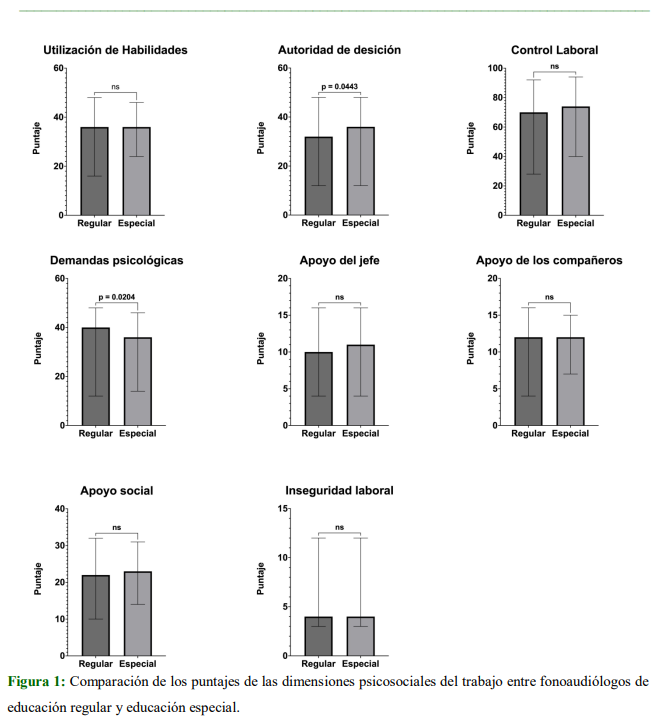
Results: Greater psychological demands were observed in regular education professionals (p = 0.020; TE = -0.170), while speech-language pathologists in special education showed greater decision-making authority (p = 0.044; TE = 0.154). No statistically significant differences were observed in skills levels used, job control, supervisor support, peer support, social support, or job insecurity (p > 0.05).
Conclusion: the findings show specific, small differences in certain psychosocial dimensions of work, without allowing us to conclude that one group has higher overall levels of work-related stress.
Article Details

This work is licensed under a Creative Commons Attribution 4.0 International License.
Usted es libre de:
- Compartir: copiar y redistribuir el material en cualquier medio o formato para cualquier propósito, incluso comercialmente.
- Adaptar: remezclar, transformar y construir a partir del material para cualquier propósito, incluso comercialmente.
- La licenciante no puede revocar estas libertades en tanto usted siga los términos de la licencia
Bajo los siguientes términos:
- Atribución: Usted debe dar crédito de manera adecuada, brindar un enlace a la licencia, e indicar si se han realizado cambios. Puede hacerlo en cualquier forma razonable, pero no de forma tal que sugiera que usted o su uso tienen el apoyo de la licenciante.
- Compartir igual: — Si remezcla, transforma o crea a partir del material, debe distribuir su contribución bajo la misma licencia del original.
- No hay restricciones adicionales — No puede aplicar términos legales ni medidas tecnológicas que restrinjan legalmente a otras a hacer cualquier uso permitido por la licencia.
References
Niedhammer I, Bertrais S, Witt K. Psychosocial work exposures and health outcomes: a metareview of 72 literature reviews with meta-analysis. Scand J Work Environ Health. 2021;47(7):489–508. doi: 10.5271/sjweh.3968
Mutlu H, Aydın OA. The relationship between job satisfaction and burnout in healthcare professionals: Meta-analysis. TJFMPC. 2024;18(2): 162-170. doi:10.21763/tjfmpc.1382695
Panagioti M, Geraghty K, Johnson J, Panagopoulou E, Chew-Graham C, Peters D,et al. Association between physician burnout and patient safety, professionalism, and patient satisfaction: systematic review and meta-analysis. Ann Intern Med. 2018;168(8):555-567. doi: 10.1001/jamainternmed.2018.3713
Khammissa RAG, Nemutandani S, Feller G, Lemmer J, Feller L. Burnout phenomenon: neurophysiological factors, clinical features and aspects of management. J Int Med Res. 2022;50(9):3000605221106428. doi: 10.1177/03000605221106428
Zúñiga-Jara S, Pizarro-León V. Mediciones de estrés laboral en docentes de un colegio público regional chileno. Inf Tecnol. 2018;29(1):171-180. doi: 10.4067/S0718-07642018000100171
Pérez A, Muñoz M, Escobar N, Santana I, Figueroa A, Martínez P, et al. Multivariate statistical analysis of the work stress phenomenon in schoolteachers during the current pandemic context in Chile. Retos. 2023;49:1011-1017. doi: 10.47197/retos.v49.98898
Ramos Monsivais CL, Castañón Vargas M, Monge Vázquez L, Almendra Andrade Y. El desgaste profesional en el ámbito educativo ¿Cómo prevenirlo? Cienc Lat Rev Cient Multidiscip. 2023;7(6):1843-1857. doi: 10.37811/cl_rcm.v7i6.8817
Gobierno de Chile. Ministerio de Educación. Orientaciones acerca de su rol y funciones en Programas de Integración Escolar (PIE). Santiago: Ministerio de Educación; 2019. Disponible en: https://kdinamarca.cl/mineduc-profesionales-asistentes-educacion-orientaciones-rol-funcionesprogramas-pie/
Biçen ŞN, Balo E. Is this really burnout? Speech and language therapists’ perspective. Int J Lang Commun Disord. 2025;60(6):e70147. doi: 10.1111/1460-6984.70147
Ewen C, Jackson CA, Galvin J. A longitudinal investigation into the relationship between working as a speech and language therapist and wellbeing. Int J Lang Commun Disord. 2025;60:e70046. doi: 10.1111/1460-6984.70046
Baixauli I, Dasí Molina M, Berenguer C. Occupational stress, burnout, and job satisfaction amongst speech-language pathologists. Int J Speech Lang Pathol. 2024;27(4):525-538. doi: 10.1080/17549507.2024.2355908
Galletta M, Portoghese I, Frau N, Pau M, Meloni F, Finco G, et al. Association between burnout and sense of coherence among speech and language therapists. Acta Biomed. 2019;90(4-S):25-31. doi: 10.23750/abm.v90i4-S.8261
Sparks K, Cooper CL. Occupational differences in the work-strain relationship. J Occup Organ Psychol. 1999;72(2):219-229. doi: 10.1348/096317999166617
Cirami L, Mur JA, Rodriguez Melgarejo A, Pereyra Girardi CI. Adaptación cultural y validación del Job Contents Questionnaire (JCQ) para trabajadores argentinos. Psicología, Conocimiento y Sociedad. 2023;13(2):50-76. doi: 10.26864/PCS.v13.n2.3.
Chiang Vega M, Gómez Fuentealba N, Sigoña Igor M. Factores psicosociales, stress y su relación con el desempeño. Salud Trab. 2013;21(2):111-128. Disponible en: https://ve.scielo.org/pdf/st/v21n2/art02.pdf
Guzmán-Muñoz E, Mendez-Rebolledo G, Concha-Cisternas Y, Alarcón-Rivera M, FaúndezCasanova C. Diseños de investigación cuantitativa en ciencias de la actividad física y la salud. Rev Cienc Act Fis UCM. 2025;26(2):63-85. doi: 10.29035/rcaf.26.2.5
Toropova A, Myrberg E, Johansson S. Teacher job satisfaction: the importance of school
working conditions. Educ Rev. 2020;73(1):71-97. doi: 10.1080/00131911.2019.1705247
Howard JT, Howard KJ. The effect of perceived stress on absenteeism and presenteeism in public school teachers. J Workplace Behav Health. 2020;35(1):1-17. doi: 10.1080/15555240.2020.1724794
Charitaki G, Koutsikou V, Spyridon S, Antoniou AS. Interventions, collaborative relationships and burnout. Psychology. 2018;9(4):679-690. doi: 10.4236/psych.2018.94042