Regional Inequalities in Epilepsy Hospitalizations in Brazil’s Unified Health System, 2014–2024
Article Sidebar
Main Article Content
Abstract
Introduction: epilepsy imposes a health and social burden. In Brazil, territorial and sociodemographic inequalities may influence hospital utilization within the Unified Health System (Sistema Único de Saúde, SUS).
Objective: to describe the regional distribution by place of hospitalization and the sociodemographic distribution of epilepsy-related hospitalizations recorded in the SUS between 2014 and 2024, and to characterize the proportion of emergency hospitalizations and in-hospital case fatality.
Methods: this ecological, descriptive, quantitative study was based on secondary data from the SUS Hospital Information System, obtained from DATASUS. Hospitalizations with a primary diagnosis of epilepsy (ICD-10: G40) were included. The unit of analysis was the hospitalization, not the patient. Region of hospitalization, sex, age group, race/skin color, type of admission, hospitalizations, and in-hospital deaths were analyzed using descriptive statistics.
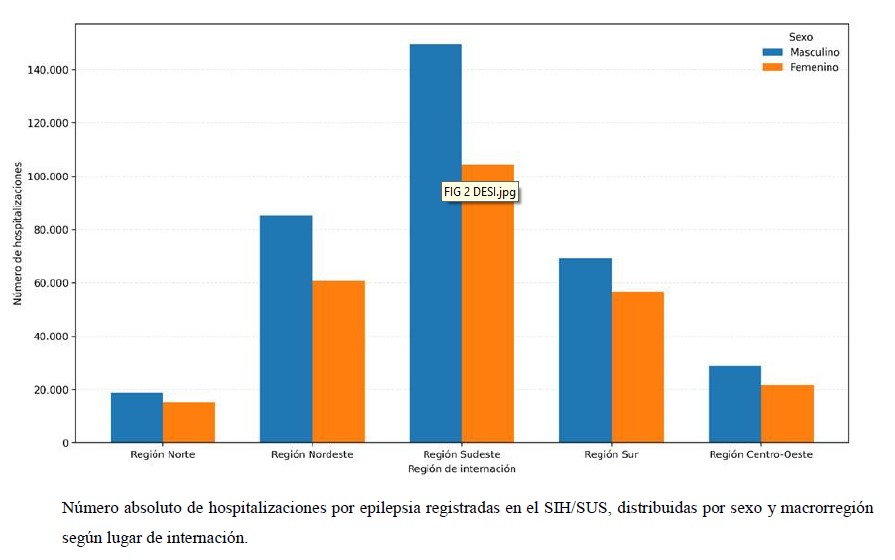
Results: overall, 610,247 hospitalizations were recorded; 564,557 were emergency hospitalizations (92.5%) and 45,690 were elective (7.5%). The Southeast accounted for 253,736 records (41.6%), followed by the Northeast and South. Men accounted for 57.7%. The 1–4-year age group had the highest frequency (100,134; 16.4%). Individuals recorded as Brown (parda) accounted for 42.1%, although race/skin color information was missing for 18.6% of records. There were 15,481 in-hospital deaths, with an approximate in-hospital case-fatality rate of 2.5%.
Conclusions: Recorded hospitalizations show important regional and sociodemographic differences. The predominance of emergency hospitalizations underscores the need to strengthen outpatient follow-up, continuity of care, and epilepsy care networks. The findings represent recorded hospitalization events, not population prevalence or individual patients.
Article Details

This work is licensed under a Creative Commons Attribution 4.0 International License.
Usted es libre de:
- Compartir: copiar y redistribuir el material en cualquier medio o formato para cualquier propósito, incluso comercialmente.
- Adaptar: remezclar, transformar y construir a partir del material para cualquier propósito, incluso comercialmente.
- La licenciante no puede revocar estas libertades en tanto usted siga los términos de la licencia
Bajo los siguientes términos:
- Atribución: Usted debe dar crédito de manera adecuada, brindar un enlace a la licencia, e indicar si se han realizado cambios. Puede hacerlo en cualquier forma razonable, pero no de forma tal que sugiera que usted o su uso tienen el apoyo de la licenciante.
- Compartir igual: — Si remezcla, transforma o crea a partir del material, debe distribuir su contribución bajo la misma licencia del original.
- No hay restricciones adicionales — No puede aplicar términos legales ni medidas tecnológicas que restrinjan legalmente a otras a hacer cualquier uso permitido por la licencia.
References
Fisher RS, Acevedo C, Arzimanoglou A, Bogacz A, Cross JH, Elger CE, et al. ILAE official report: a practical clinical definition of epilepsy. Epilepsia. 2014;55(4):475-82. doi: 10.1111/epi.12550
World Health Organization. Epilepsy. Geneva: WHO; 2024 [citado22 Jun 2026]. Disponible en: https://www.who.int/news-room/fact-sheets/detail/epilepsy
Fiest KM, Sauro KM, Wiebe S, Patten SB, Kwon CS, Dykeman J, et al. Prevalence and incidence of epilepsy: a systematic review and meta-analysis of international studies. Neurology. 2017;88(3):296-303. doi: 10.1212/WNL.0000000000003509
Noronha AL, Borges MA, Marques LH, Zanetta DM, Fernandes PT, de Boer H, et al. Prevalence and pattern of epilepsy treatment in different socioeconomic classes in Brazil. Epilepsia. 2007;48(5):880-5. doi: 10.1111/j.1528-1167.2006.00974.x
Brasil. Ministério da Saúde. Departamento de Informática do Sistema Único de Saúde. Sistema de Informações Hospitalares do SUS – SIH/SUS. 2026. Brasília: Ministério da Saúde; [citado 22 Jun 2026]. Disponible en: http://sihd.datasus.gov.br/principal/index.php
Scheffer IE, Berkovic S, Capovilla G, Connolly MB, French J, Guilhoto L, et al. ILAE classification of the epilepsies: position paper of the ILAE Commission for Classification and Terminology. Epilepsia. 2017;58(4):512-521. doi: 10.1111/epi.13709
Brasil. Ministério da Saúde. Departamento de Informática do Sistema Único de Saúde. Informações de Saúde (TABNET). 2026. Brasília: Ministério da Saúde; [citado 22 Jun 2026]. Disponible en: https://datasus.saude.gov.br/informacoes-de-saude-tabnet/
World Health Organization. International statistical classification of diseases and related health problems, 10th revision. Geneva: WHO; 2019 [citado 22 Jun 2026]. Disponible en: https://icd.who.int/browse10/2019/en
Brasil. Ministério da Saúde. Conselho Nacional de Saúde. Resolução No 510, de 7 de abril de 2016. Brasília: Ministério da Saúde/Conselho Nacional de Saúde; 2016 [citado22 Jun 2026]. Disponible en: https://www.gov.br/conselho-nacional-de-saude/pt-br/atos-normativos/resolucoes/2016/resolucao-no-510.pdf
World Medical Association. World Medical Association Declaration of Helsinki: ethical principles for medical research involving human subjects. JAMA. 2013;310(20):2191-4. doi:10.1001/jama.2013.281053
Madeira AB, Pereira IB, Nunes LC, Pedrosa LMC, Tavares DSA. Internações e óbitos por epilepsia no Brasil: uma análise ecológica de 2013-2023. Braz J Health Rev. 2024;7(5):e73424. doi: 10.34119/bjhrv7n5-369
Fonseca FG, Veloso FMF, Pessoa IMS, Ferreira ACGR. Prevalência de internações por epilepsia no Brasil. J Soc Issues Health Sci. 2024;1(6):1-7. doi: 10.5281/zenodo.13847873
Meyer AC, Dua T, Ma J, Saxena S, Birbeck G. Global disparities in the epilepsy treatment gap: a systematic review. Bull World Health Organ. 2010;88(4):260-6. doi: 10.2471/BLT.09.064147
Kwan P, Brodie MJ. Early identification of refractory epilepsy. N Engl J Med. 2000;342(5):314-9. doi: 10.1056/NEJM200002033420503
Sampaio LP, Caboclo LO, Kuramoto K, Reche A, Yacubian EM, Manreza ML. Prevalence of epilepsy in children from a Brazilian area of high deprivation. Pediatr Neurol. 2010;42(2):111-7. doi: 10.1016/j.pediatrneurol.2009.09.002
Camfield P, Camfield C. Incidence, prevalence and aetiology of seizures and epilepsy in children. EpilepticDisord. 2015;17(2):117-23. doi: 10.1684/epd.2015.0736
Beghi E, Giussani G. Aging and the Epidemiology of Epilepsy. Neuroepidemiology. 2018;51(3-4):216-223. doi.: 10.1159/000493484
Christensen J, Kjeldsen MJ, Andersen H, Friis ML, Sidenius P. Gender differences in epilepsy. Epilepsia. 2005;46(6):956-960. doi: 10.1111/j.1528-1167.2005.51204.x
Reddy DS, Thompson W, Calderara G. Molecular mechanisms of sex differences in epilepsy and seizure susceptibility in chemical, genetic and acquired epileptogenesis. Neurosci Lett. 2021;750:135753. doi: 10.1016/j.neulet.2021.135753
Travassos C, Williams DR. The concept and measurement of race and their relationship to public health: a review focused on Brazil and the United States. Cad Saude Publica. 2004;20(3):660-78. doi: 10.1590/s0102-311x2004000300003
Alfradique ME, Bonolo PF, Dourado I, Lima-Costa MF, Macinko J, Mendonça CS, et al. Internações por condições sensíveis à atenção primária: a construção da lista brasileira como ferramenta para medir o desempenho do sistema de saúde (Projeto ICSAP – Brasil). Cad Saude Publica. 2009;25(6):1337-1349. doi: 10.1590/S0102-311X2009000600016
Macinko J, Harris MJ. Brazil's family health strategy--delivering community-based primary care in a universal health system. N Engl J Med. 2015;372(23):2177-81. doi: 10.1056/NEJMp1501140
Trinka E, Cock H, Hesdorffer D, Rossetti AO, Scheffer IE, Shinnar S, et al. A definition and classification of status epilepticus--Report of the ILAE Task Force on Classification of Status Epilepticus. Epilepsia. 2015;56(10):1515-23. doi: 10.1111/epi.13121
Betjemann JP, Lowenstein DH. Status epilepticus in adults. Lancet Neurol. 2015;14(6):615-24. doi: 10.1016/S1474-4422(15)00042-3
GBD 2016 Epilepsy Collaborators. Global, regional, and national burden of epilepsy, 1990- 2016: a systematic analysis for the Global Burden of Disease Study 2016. Lancet Neurol. 2019;18(4):357-375. doi.: 10.1016/S1474-4422(18)30454-X
World Health Organization. Intersectoral global action plan on epilepsy and other neurological disorders 2022–2031. Geneva: World Health Organization; 2025 [citado23 Jun 2026]. Disponible en: https://www.who.int/publications/i/item/9789240076624
Bittencourt SA, Camacho LAB, Leal MC. O Sistema de Informação Hospitalar e sua aplicação na saúde coletiva. Cad Saude Publica. 2006;22(1):19-30. doi: 10.1590/S0102-311X2006000100003