Incomplete Ross syndrome. A Case presentation
Article Sidebar
Main Article Content
Abstract
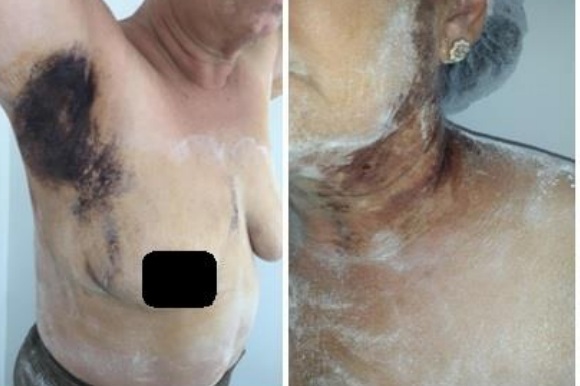
Ross syndrome is a rare autonomic disorder characterized by segmental hypohidrosis or anhidrosis, tonic pupil, and hyporeflexia or areflexia. A 58-year-old woman with type 2 diabetes mellitus presented with a hypopigmented patch on the left hemithorax and a 15-year history of asymmetric sweating, which had worsened over the preceding two months. Starch–iodine testing demonstrated areas of reduced sweating and compensatory hyperhidrosis. Ophthalmological examination identified an abnormal left pupillary response. Deep tendon reflexes were preserved except for the left Achilles reflex, attributed to a previous injury. The segmental sweating deficit and unilateral pupillary abnormality supported a working diagnosis of incomplete Ross syndrome. Oral oxybutynin provided limited benefit and was discontinued because of adverse effects. Intradermal botulinum toxin improved sweating in treated areas, but hyperhidrosis increased in adjacent regions.
This case highlights the importance of investigating underlying hypohidrosis in patients with asymmetric hyperhidrosis and illustrates the challenges of symptomatic management.
Article Details

This work is licensed under a Creative Commons Attribution 4.0 International License.
Usted es libre de:
- Compartir: copiar y redistribuir el material en cualquier medio o formato para cualquier propósito, incluso comercialmente.
- Adaptar: remezclar, transformar y construir a partir del material para cualquier propósito, incluso comercialmente.
- La licenciante no puede revocar estas libertades en tanto usted siga los términos de la licencia
Bajo los siguientes términos:
- Atribución: Usted debe dar crédito de manera adecuada, brindar un enlace a la licencia, e indicar si se han realizado cambios. Puede hacerlo en cualquier forma razonable, pero no de forma tal que sugiera que usted o su uso tienen el apoyo de la licenciante.
- Compartir igual: — Si remezcla, transforma o crea a partir del material, debe distribuir su contribución bajo la misma licencia del original.
- No hay restricciones adicionales — No puede aplicar términos legales ni medidas tecnológicas que restrinjan legalmente a otras a hacer cualquier uso permitido por la licencia.
References
Sawhney MPS, Sharma YK, Singh N. Segmental anhidrosis with hyporeflexia associated with congenital spinal deformity: a Ross's syndrome variant or inverse Horner's syndrome? Indian J Dermatol Venereol Leprol. 2004;70(1):29–32. Disponible en: https://utoronto.scholaris.ca/server/api/core/bitstreams/cd48f6a7-7527-4cac-9908-b377ecc5a052/content
Agarwala MK, George L, Parmar H, Mathew V. Ross syndrome: a case report and review of cases from India. Indian J Dermatol. 2016;61(3):348. doi: 10.4103/0019-5154.182472
Kumar P, Das A, Mondal AK, Kumar J, Chattopadhyay SS, Guha G, et al. A lady presenting with segmental anhidrosis and heat intolerance. Indian Dermatol Online J. 2015;6(2):126–127. doi: 10.4103/2229-5178.153019
Nagane Y, Utsugisawa K. Ross syndrome associated with cytomegalovirus infection. Muscle Nerve. 2008;38(1):924–926. doi: 10.1002/mus.21004
Vasudevan B, Sawhney MPS, Vishal S. Ross syndrome with ANA positivity: a clue to possible autoimmune origin and treatment with intravenous immunoglobulin. Indian J Dermatol. 2010;55(3):274–276. doi: 10.4103/0019-5154.70694
Luong M, Jomir L, Labauge P, Dandurand M, Meunier L, Stoebner PE. Ross syndrome with sweating anomaly associated with Sjögren syndrome: an infrared thermographic case study. Acta Derm Venereol. 2011;91(1):80–81.
Lamotte G, Sandroni P, Cutsforth-Gregory JK, Berini SE, Benarroch EE, Shouman K, et al. Clinical presentation and autonomic profile in Ross syndrome. J Neurol. 2021;268(10):3852–3860. doi: 10.1007/s00415-021-10531-8
Pérez-García P, Bernat-García J, Mateu-Puchades A. Síndrome de Ross en varón de 38 años. Dermatol Online J. 2013;19(1):6. Disponible en: https://www.intramed.net/content/sindrome-deross-en-un-varon-de-38-anos
Balcells A, Sanahuja J, Guitard L, Albertí A, Ortiz A, Barcenilla F. Síndrome de Ross: una causa infrecuente neurológica de trastorno de la sudoración. Rev Neurol. 2014;59(7):334–335. doi: 10.33588/rn.5907.2014155
Baran A, Balbaba M, Demir CF, Ozdemir HH. A case of Ross syndrome presented with Horner and chronic cough. J Neurosci Rural Pract. 2014;5(4):394–397. doi: 10.4103/0976-3147.139997
Pop-Busui R, Boulton AJM, Feldman EL, Bril V, Freeman R, Malik RA, et al. Diabetic neuropathy: a position statement by the American Diabetes Association. Diabetes Care. 2017;40(1):136–154. doi: 10.2337/dc16-2042
Devigili G, Rinaldo S, Lombardi R, Cazzato D, Marchi M, Salvi E, et al. Diagnostic criteria for small fibre neuropathy in clinical practice and research. Brain. 2019;142(12):3728–3736. doi: 10.1093/brain/awz333